
Cullingworth Mills

Cullingworth Mills – Antiques, Yorkshire Mill History and The Mill Café
Some places you visit because you've planned to go there. Others you simply stumble across while you're out exploring, and they turn out to be one of the best parts of the day.
Cullingworth Mills was one of those places for us.
We discovered the mill while walking our Harden Circular Walk, a 4.41-mile route through the countryside around Harden and Cullingworth, including Goit Stock Wood and Goit Stock Waterfall.
Coming across an old Yorkshire mill is always enough to get my attention.
I love old mills. Lyn reckons I worked in a mill in another life – I like to think I owned it!!
So naturally, we had to go in.
What we found was a fascinating old industrial building that has been given an entirely new life, filled with antiques, vintage furniture, collectables, independent dealers and unusual things to browse.
And, importantly after a walk, there's also a very nice café.
Cullingworth Mills at a Glance
Location: Cullingworth, West Yorkshire
Address: Cullingworth Mills, Greenside Lane, Cullingworth, West Yorkshire, BD13 5AB
Opening hours: Monday to Saturday 10am–5pm; Sunday 10am–4pm
Parking: Ample free parking within the mill complex
Café: The Mill Cullingworth
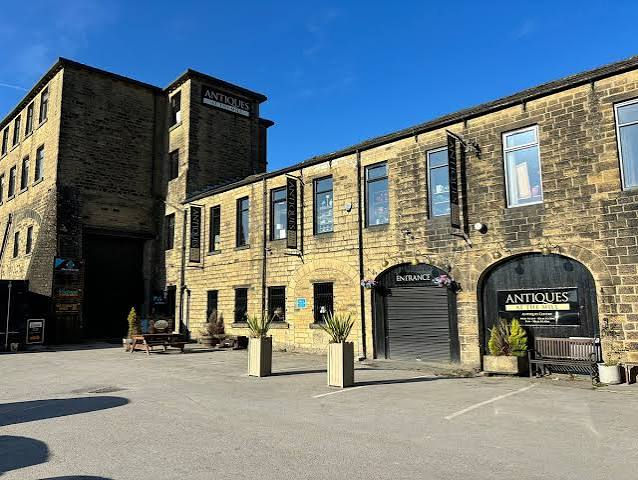
Antiques and vintage: More than 100 dealers across the different businesses at the mill
Best for: Antiques, vintage furniture, collectables, Yorkshire industrial heritage, independent shopping and a café stop
Nearby: Goit Stock Wood, Goit Stock Waterfall, Hewenden Viaduct, Hewenden Reservoir, Harden and Haworth
Official website: Cullingworth Mills
Nearby White Shire walk: Harden Circular Walk
A Yorkshire Mill Worth Exploring
Cullingworth Mills stands on Greenside Lane in the village of Cullingworth, between Bradford, Bingley and Keighley.
Today, the surviving buildings are home to a collection of independent businesses, but the site began life during one of the most important periods in Yorkshire's industrial history.
The Cullingworth Mills website dates the origins of the mill to 1852, when the textile industry was transforming towns and villages across West Yorkshire.
This part of Yorkshire became one of the great textile-producing areas of Britain.
Mills appeared throughout the valleys and villages around Bradford and Keighley, and communities grew around the work they provided.
Cullingworth was no exception.
The Industrial History of Cullingworth Mills
Cullingworth Mills was run by the Townend Brothers, a prominent local family involved in both textiles and coal mining.
The mill became particularly associated with worsted production and is recorded by the mill as the first maker of worsted heald yarns in the Bradford district.
At its height, Cullingworth Mills employed around 800 people.
It's quite a thought when you're wandering through the building today.
You can browse quietly through antique furniture and old collectables, but once this would have been a very different place.
There would have been machinery running, workers moving through the buildings, carts and deliveries arriving and an entire village whose economy was closely connected with what happened inside the mill.
That is one of the reasons I find old mills fascinating.
Even when their original purpose has disappeared, you can still get a sense of the scale of the industry that once occupied them.

Coal, Gas and the Village
The Townend family also operated local coal pits at Denholme, Dene Brow, Hazel Crook and Hollin Hall.
Coal from these pits supplied the gas works located within the Cullingworth Mills complex.
Those gas works didn't just serve the factory.
They also supplied gas to the village of Cullingworth.
It shows how much these large industrial sites were woven into everyday life.
A mill wasn't simply somewhere people went to work. It could provide employment, power infrastructure and a focus around which an entire community developed.
The Cullingworth Mills Fire
Like many Yorkshire textile mills, Cullingworth Mills eventually faced the decline of Britain's traditional textile industry.
The most dramatic moment in the surviving mill's more recent history came in September 1973.
A major fire destroyed the largest section of the complex.
Historic photographs show just how extensive the original mill once was and how much was lost.
Thankfully, parts of the site survived.
The current owners purchased the remaining mill buildings in 2013, and they have since been adapted for a completely different generation of businesses.
Rather than becoming another abandoned industrial building or disappearing altogether, Cullingworth Mills has retained part of its historic character while finding a modern purpose.
Antiques At The Mill
One of the biggest attractions today is Antiques At The Mill.
It spreads across two floors and has more than 90 dealers and artisans selling antiques, collectables and handcrafted pieces.
This isn't the sort of place where everyone heads towards the same few displays.
You wander.
One room leads to another, cabinets are filled with all sorts of things, and every dealer seems to bring something different.
There are pieces of furniture, decorative items, collectables, old household objects and plenty of things that make you stop and wonder what they were originally used for.
You don't have to be a serious antiques collector to enjoy it.
Half the pleasure is simply looking.

Vintage At The Mill
If your tastes are more twentieth century, Vintage At The Mill concentrates on mid-century, vintage and retro furniture and interiors.
You'll find designs from names including Ercol and G Plan alongside other pieces from the period.
There has been a big revival in interest in mid-century furniture, and this is a much better way to see it than looking at photographs online.
You can properly appreciate the construction, timber, proportions and condition of a piece.
And of course, there's always the danger that you arrive just for a look and leave wondering whether something will fit in the car.
The Weaving Shed
The Weaving Shed brings another group of independent dealers together inside the complex.
There are twelve dealers offering a mixture of antiques, salvage, retro and vintage items.
Again, that's what makes the mill interesting.
It's not one large shop with everything selected by one buyer.
Different dealers bring different interests and tastes, which means the contents can change and there is always the possibility of finding something unusual.
The Mill Cullingworth Café
After browsing the mill – or in our case walking several miles first – there's another very good reason to visit.
The Mill Cullingworth is the café at the mill.
We stopped there during our visit and really liked it.
It's exactly the sort of place that works well alongside an attraction like this.
You can have a good wander around the antiques, stop for something to eat or a coffee, then go back for another look if something caught your eye.
For us, finding somewhere decent for a coffee is always a bonus when we're out walking.
Sometimes it's considerably more than a bonus.
It becomes the destination.
The café was previously known as Spoons Tearoom, but it is now called The Mill Cullingworth.
If you're planning a visit specifically for the café, use the current Google listing for The Mill Cullingworth to check the latest opening information before travelling.

We Found Cullingworth Mills on Our Harden Circular Walk
One of the reasons we're adding Cullingworth Mills to The White Shire's attractions is because we found it while doing something else entirely.
Our Harden Circular Walk takes you through the countryside around Harden and Cullingworth and into Goit Stock Wood.
Goit Stock Waterfall is one of the highlights of the route, particularly when there has been enough rain to get plenty of water flowing.
The route is 4.41 miles and we class it as moderate.
Most of the distance isn't particularly difficult, although the woodland around the waterfalls can become rocky, slippery and muddy depending on conditions.
Cullingworth Mills gives the walk another dimension.
You move from countryside and woodland into a place that represents the industrial history of West Yorkshire.
That mixture is something we particularly enjoy about walking around this part of the county.
Yorkshire's countryside and industrial past are often sitting right next to each other.
A woodland path can lead towards an old mill, a reservoir may have been built to serve industry, and villages that look peaceful today were once filled with textile workers, miners and factories.
If you'd like to visit Cullingworth Mills as part of the same day out, have a look at our complete Harden Circular Walk guide.
Walks Around Cullingworth
Cullingworth Mills is also well placed for exploring the wider area on foot.
A nearby footpath leads towards Hewenden Viaduct and Hewenden Reservoir.
In the other direction, countryside paths lead towards Goit Stock and its woodland and waterfalls.
Haworth is only a few miles away, putting Cullingworth within easy reach of Brontë Country and some of West Yorkshire's best-known landscapes.
If you enjoy exploring Yorkshire on foot, our West Yorkshire Walks collection includes personally walked routes through villages, woodland, reservoirs, former industrial landscapes and countryside across the region.
You can also browse our wider collection of Yorkshire Walks.
Parking at Cullingworth Mills
Cullingworth Mills has ample free parking.
When you turn onto Greenside Lane, look for the distinctive arched entrance to the mill.
Drive through the arch and the parking area is within the complex.
Free parking makes it easy to spend a couple of hours browsing without feeling that you need to rush.
It also makes the mill a useful place to include when exploring Cullingworth and the surrounding countryside.
Getting There by Public Transport
Cullingworth is served by buses from Bradford Interchange and Keighley bus station.
The nearest local railway stations are Bingley and Keighley.
If you're travelling by public transport, check current bus and rail times before setting off, as services can change.
Opening Times
Cullingworth Mills currently lists its main opening hours as:
Monday: 10am–5pm
Tuesday: 10am–5pm
Wednesday: 10am–5pm
Thursday: 10am–5pm
Friday: 10am–5pm
Saturday: 10am–5pm
Sunday: 10am–4pm
Individual businesses within the mill, including The Mill Cullingworth café, may operate different hours.
Always check Cullingworth Mills and the current listing for The Mill Cullingworth before making a special journey.
Is Cullingworth Mills Worth Visiting?
We think it is.
This isn't a conventional museum or a polished visitor attraction where you're directed through a fixed route.
It feels much more informal than that.
You wander through a genuine old Yorkshire mill, explore independent antique and vintage dealers, find things you weren't expecting to find and stop for a coffee at The Mill.
The history of the building gives the whole place extra character.
There are plenty of new retail developments where you could put the same businesses, but they wouldn't feel the same.
The old brickwork, the scale of the building and the knowledge that generations of people once worked here are all part of the experience.
For us, Cullingworth Mills is exactly the sort of place that belongs on The White Shire.
It's interesting, it's local and it's somewhere you could easily pass without realising what is inside.
And, naturally, it involves an old mill.
Lyn can carry on claiming I worked in one in another life.
I'm still convinced I owned it.
Discover More Yorkshire Attractions
Cullingworth Mills is one of the many places across Yorkshire that might not immediately appear on a conventional list of major tourist attractions but is well worth discovering.
That's exactly what our Yorkshire Attractions section is about.
We feature historic buildings, unusual places, landscapes, independent attractions and those Yorkshire discoveries that make you think, "I've driven past there loads of times and never knew that was there."
And if you'd like to discover Cullingworth Mills the way we did, start with our Harden Circular Walk, explore Goit Stock Waterfall and leave enough time for a wander around the mill and a coffee afterwards.
Quick Facts About Cullingworth Mills
Cullingworth Mills is in Cullingworth, West Yorkshire.
The mill dates its origins to 1852.
It became an important part of Cullingworth's textile industry.
At its peak the mill employed around 800 workers.
The Townend family was involved in both textile manufacturing and local coal mining.
The mill's gas works also supplied gas to Cullingworth village.
A major fire destroyed the largest section of the mill in September 1973.
The current owners purchased the remaining mill buildings in 2013.
Today Cullingworth Mills showcases more than 100 antiques, vintage and independent dealers.
Antiques At The Mill has more than 90 dealers and artisans across two floors.
The Weaving Shed has twelve independent dealers.
Vintage At The Mill specialises in mid-century, vintage and retro furniture.
The café is now called The Mill Cullingworth.
There is ample free parking.
Cullingworth Mills is close to Hewenden Viaduct, Hewenden Reservoir, Goit Stock Wood and Goit Stock Waterfall.
We discovered the mill while doing our Harden Circular Walk.
Click on the links below to listen to our podcasts


TThe Historical Aire and Calder: A Journey Through Timehe Historical Aire and Calder: A Journey Through Time

Comments